
Author Archive

Is God in Hell?

I recently perused a popular church‘s doctrinal statement, in which the article on “Eternity” read:

“Man was created to exist forever.  He will exist either eternally separated from God by sin or in union with God through forgiveness and salvation. To be eternally separated from God is Hell.  To be eternally in union with Him is Heaven.  Heaven and Hell are places of eternal existence.”

I also found this confession to quite popular (word-for-word so) among churches influenced by this particular ministry.  Therefore, it’s not an irrelevant confession but one with substantial influence.  With the resurgence of attention on hell from Rob Bell and the like, we do well to consider what hell is or if it is at all.

This confession about eternity should be commended where credit is due.  It certainly is brief and demands expounding but it is concisely helpful in two ways.  One, God did create man to live forever in either one of two places: heaven or hell.  And, two, they are indeed places of eternal existence.  Thankfully, this confession says far more than many churches are willing to say.  But does it go far enough?

Again, the confession does not go into much detail about the nature of heaven or hell.  Therefore, I’ll not take issue with what it does not say.  What it does say particularly about hell is that “To be eternally separated from God is Hell.”  In other words, Hell is the eternal absence of God or Hell is where God is eternally not.

At first blush, perhaps we shouldn’t concern ourselves too much with this definition of hell.  Being one for hair-splitting, I hope not to cast any aspersion on those who wrote it or now espouse it.  I simply want to interact with it at face value.  Is Hell eternal separation from God or is it the eternal vengeance of God?  Again, if the latter is indeed meant then I simply apologize but ask that we be clearer in our language.

Hell is not the eternal absence of God or eternal separation from God.  Rather, God is very present in hell but present in the entirety of his wrath.  In other words, God will not eternally leave the unbelieving in Jesus to their own devices, but will for eternity pour out his contempt on them for their rebellion against the universe’s Risen King.  This is to say, and perhaps contrary to mainstream opinion, Satan does not rule hell.  God rules hell as surely as he rules heaven.

We have hints of this in the Old Testament.  David confessed that no matter where he went he could not escape God’s presence (Ps 139.7-12).  Whatever one decides about the nature of Sheol (v8) we know in David’s mind (1) it stood opposite of heaven and (2) God was there, too, just as he was in heaven.

Contrasting the eternal state, God spoke through Isaiah about a new heavens and earth where God unleashes his blessing (Is 66.22-23).  This over against an unnamed place where those who have transgressed against God will suffer eternal fire, unsatiated worms, and hatred forever (v24).  Hell is not a party where Satan is the master of ceremonies.  Hell is the place where God pours out his unmitigated wrath on all who have transgressed him.

As we come to the New Testament, hell comes into sharper focus.  Jesus clears some of the fog that rested on the OT authors in regards to the eternal state.  In Matthew 10.28, Jesus warned:

“Do not fear those who kill the body but are unable to kill the soul; but rather fear Him who is able to destroy both soul and body in hell.”

While an argument could be made the “him” who is able to destroy body and soul in hell is Satan, the context clearly suggests God is to be feared over men.  Don’t fear what men can do to you for confessing Christ, but fear what God will do to those who don’t.

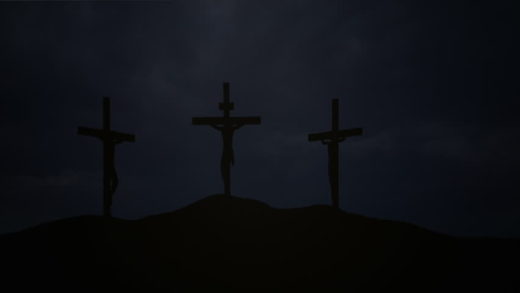
At the cross, Jesus did not endure the Father’s absence.  He endured the fullness of the Father’s wrath.  We see this in one sense by the imagery of the “cup” Jesus drank.  The OT speaks of those who suffer God’s wrath as drinking his cup of anger (e.g. Is 51.17, 22).

Correcting the Sons of Thunder, Jesus assured James and John they were not able to drink the cup Jesus was soon to drink (Mt 20.22).  The cup of the Father’s wrath came with only one straw.  And there was only one who could down that gall to its dregs.

The reality of the Father’s forsaking Jesus wasn’t merely that Jesus was separated from the Father.  He was forsaken in that Jesus became before the Father all that He despised, hated and cursed.  He wasn’t forsaken in that he was left alone, but that he left devoid of all mercy and subject to all wrath.  God’s face, so brightly shining at the Son’s  baptism, became a dark, frown as the Son became sin for us.  Jesus went through hell in that he endured the fullness of the Father’s wrath on all sin and sinners for all time for all those who would believe.

The author of Hebrew described the fate of those whose sins are not covered by Christ (Heb 10.26-31).  Those with no sacrifice for their sins can only expect “THE FURY OF A FIRE WHICH WILL CONSUME THE ADVERSARIES” (v27; cf. Is 26.11).  He then argues that if disregard for Moses’ Law merited a merciless eternity then how much more severe an eternity awaits those who disregard Christ’s gospel (v29).  God’s vengeance is sure (v30) and it is a “terrifying thing to fall into the hands of the living God” (v31).  In other words, if you die without Christ you die with no sacrifice in your place.  That doesn’t mean you slip into a Godless eternity, but into a eternity where God repays his vengeance on those who, by their unbelief, “trampled under foot the Son of God” and “regarded the blood of the [new] covenant unclean” and “insulted the Spirit of grace.”  God will be as present in hell in his wrath as he is present in heaven in his blessing.

God let the Apostle John in on the clearest vision of the nature of hell.  He saw the beast and false prophet “thrown alive into the lake of fire which burns with brimstone” (Rev 19.20).  He then saw the devil himself (Satan) “thrown into the lake of fire and brimstone, where the beast and the false prophet are also; and they will be tormented day and night forever and ever” (Rev 20.10; emphasis mine).  He then saw all those whose names were not written “in the book of life” were “thrown into the lake of fire” (Rev 20.15).  Drawing images together, John earlier saw those dying in Satan’s kingdom as eternally “drink[ing] of the wine of the wrath of God, which is mixed in full strength in the cup of his anger.”

Oh, friend, consider that God will treat unbelievers just like he will Satan for all eternity!  Oh, dear Christian, that means that God will treat all believers just like Jesus for all eternity!

Hell is not the unbeliever’s eternal party where Satan bartends and deejays.  It is where God serves up the cup of wrath (drank by Jesus at the cross for all believers) for eternity.  Satan is not in charge of torment in hell.  He himself is suffering torment and that from the hand of God himself.

Again, Satan is not in charge of hell.  God is.  And God takes out his full, unmitigated wrath on all unbelievers along with Satan himself.  God does not leave hell in the hands of Satan to do what he wills with those there.  Hell is God’s hell and where he unleashes his eternal punishment on rebellious sinners who refused to worship Jesus.

Eternal separation from God would be a relief.  But such is not the case when speaking of hell.  Hell is not eternal separation from God.  In fact, it’s quite the opposite.  It is eternal suffering from the hand of God.

Hear, in closing, the Belgic Confession (1619):

Finally we believe, according to God’s Word, that when the time appointed by the Lord is come (which is unknown to all creatures) and the number of the elect is complete, our Lord Jesus Christ will come from heaven, bodily and visibly, as he ascended, with great glory and majesty, to declare himself the judge of the living and the dead. He will burn this old world, in fire and flame, in order to cleanse it.

Then all human creatures will appear in person before the great judge – men, women, and children, who have lived from the beginning until the end of the world.

They will be summoned there by the voice of the archangel and by the sound of the divine trumpet.

For all those who died before that time will be raised from the earth, their spirits being joined and united with their own bodies in which they lived. And as for those who are still alive, they will not die like the others but will be changed “in the twinkling of an eye” from “corruptible to incorruptible.”

Then “the books” (that is, the consciences) will be opened, and the dead will be judged according to the things they did in the world, whether good or evil. Indeed, all people will give account of all the idle words they have spoken, which the world regards as only playing games. And then the secrets and hypocrisies of men will be publicly uncovered in the sight of all.

Therefore, with good reason the thought of this judgment is horrible and dreadful to wicked and evil people. But it is very pleasant and a great comfort to the righteous and elect, since their total redemption will then be accomplished. They will then receive the fruits of their labor and of the trouble they have suffered; their innocence will be openly recognized by all; and they will see the terrible vengeance that God will bring on the evil ones who tyrannized, oppressed, and tormented them in this world.

The evil ones will be convicted by the witness of their own consciences, and shall be made immortal – but only to be tormented in the everlasting fire prepared for the devil and his angels.

In contrast, the faithful and elect will be crowned with glory and honor. The Son of God will “confess their names” before God his Father and the holy and elect angels; all tears will be “wiped from their eyes”; and their cause – at present condemned as heretical and evil by many judges and civil officers – will be acknowledged as the “cause of the Son of God.”

And as a gracious reward the Lord will make them possess a glory such as the heart of man could never imagine.

So we look forward to that great day with longing in order to enjoy fully the promises of God in Christ Jesus, our Lord.

Amen.  Come, Lord Jesus.

Tags:

23

01 2012

The Church is Messed Up…For Now.

I love the church.  Jesus died for her (Eph 5.2, 25) and it’s good to love those for whom Jesus died.  But she is one messed-up group of people, in large part because I am one messed-up person.

Jesus gave himself up for the church not because of who the church was but because of who he would make the church to be.  Jesus knew full well his church would never be perfect in this life.  He would have to sanctify her until the last day, when he would raise up new bodies to present to his Father (Eph 5.26-27).  We serve an illusion if we think our churches will be spotless, wrinkle-free, holy and blameless before the day Jesus presents her on that day.  It was never Jesus’ intention to create the perfect church in this age,  but to preserve a faithful people who ride the ups-and-downs of sin, pain, sorrow and joy by faith in the One to Come.

In the meantime, we are one messed-up group of people running a difficult race of faith.

The Reformers identified the true marks of a church to be the right preaching of God’s word, the right administration of the sacraments/ordinances and the exercise of church discipline.  Any church trying to hit those marks will go through some very painful circumstances.  When Jesus came on the Galilean scene, demons came out of nowhere to go toe-to-toe with the one they knew would destroy them.  Likewise, striving for and maintaining healthy churches means meeting sin and Satan in the dark alleys of human hearts.  And no one comes away without scars in that fight.

Have you considered the reason why we have thirteen New Testament letters?  They’re all, in one sense or another, responses to church conflicts.  There were no perfect churches in the NT and, in fact, we’re surprised to see some groups of NT believers still even considered part of the church!  Jesus seven letters in Revelation 2-3 were to confront imperfect churches.  Until the end of time, Christ’s church will not be what she will be when Christ gets done with her on the last day.

The ministry of Jesus invited conflict.  Therefore, true gospel ministry invites conflict in the “best” of churches.  We don’t relish the conflict, but we’re not surprised or excessively despaired by it.  In fact, conflict is often the means of testing faithfulness (2 Cor 2.9) and reminding us that we’re not There yet and therefore must keep eyes fixed on Christ.

We can ignore conflict, wanting to avoid the hard work of communal accountability to the gospel.  We let folks slip out the side-door so as to avoid any confrontation and stain of scandal.

We can exaggerate conflict, assuming Satan is successfully destroying the church.  But Satan only has as much leash as God allows.

We can understate conflict, acting like it’s not there until the cancer takes over major organs.  Suddenly a group is “led by the Spirit” to start a new church.

We can fear conflict, running from it so much that we end up being with people who are exactly like us.

Or, we can consider conflict biblically.  In the best of churches, conflict will happen.  That’s why we have most of the New Testament.  Therefore:

  • We should be honest about it.  The world doesn’t need to see a superficial billboard of smiling suburbanites.  The world needs to see a community of sinners who have found Living Hope in the gospel.
  • We shouldn’t be surprised by it if we’re striving to be healthy churches.  Satan has declared war on the church (Rev 12.17) and when we poke him he snarls.
  • We should see it in light of the big picture.  Christ is sanctifying a global community and we’re barely a sliver of it.  Whatever conflict we face in the American church should be seen in light of the persecution of Christians in most of the rest of the world.
  • We should consider conflict part of God’s means of sanctifying his people.  We still need Christ to redeem, repent and restore.
  • We shouldn’t consider a healthy church the one without any conflict.  The healthy church is one who deals with conflict in a Christ-exalting, saint-loving, purity-protecting way.

While conflict shouldn’t dominate a church’s life, it will be a regular condition in the life of the church.  Such is life in the age of groaning (Rom 8.22-24).  There will always be someone(s) giving into temptation, incubating wicked thoughts, hiding secret sins, etc.  The joy of Christian ministry is not making sure everyone looks perfect, but in making sure everyone is hoping in Christ and his perfections.

We live in the age of the hope of glory (Rom 5.2; Col 1.27), knowing the day is coming soon when we will finally, and in reality, be the glorious people for whom Christ died.  Until then “with perseverance we wait eagerly for it” (Rom 8.25).

11

01 2012

Hate Sin? Prove it!

“…as sin reigned in death, even so grace would reign through righteousness to eternal life through Jesus Christ our Lord” (Rom 5.21).

It’s stock language in the Christian life that we’re to “hate sin” and “kill sin.”  Sin is indeed an interloper in the Christian soul, a squatter in the Spirit-indwelled heart.  Because of Christ, sin has no rights, privileges or legal claim on the Christian.  Therefore, it must be rooted out and put to death.  We are strengthened by the Holy Spirit to make progress against particular sins and toward Christlikeness.  Though a lifelong process, the mortification of sin is a hopeful process because Jesus has removed its sting (1 Cor 15.55-57).  I’m far more empowered to kill something that I’m assured cannot kill me back!

But, as pious as hating and killing sin sounds how do we go about it?  What metric do I use to determine how much I hate sin?  Is it enough to merely say we categorically hate sin really, really bad?  Is our hatred of sin to be measured by how bad we feel after committing it?  Does killing sin mean spending our days not sinning in certain ways?  Are we to wake up each day trying not to sin as a means of mortifying it?

Jesus taught us to be violently aggressive against sin.  We’re to cut out the wandering eye and cut off the offending hand, as it were (Mt 18.8-9).  Guerrilla warfare has no rules and sin is our fiercest guerrillero; therefore, killing is rarely easy and often messy.  We’re not merely to hate the category of sin, but to kill “the deeds of the body” in the power of the Holy Spirit (Rom 8.13).  It’s one thing to hate weeds in my yard while staring at them from the kitchen window, but quite another to get dirty pulling up the particular weeds.  We’re called to hate and mortify sin by being done with sins.

That said, I might suggest one metric to measure hatred for sin and a corresponding tactic for killing it.  Sin reigns in death, grace reigns through righteousness.  The grace that saves is the grace that demonstrates its power (reign) in sin-killing righteousness.  In other words, saving grace is not only measured by how much sin we get away with while still remaining God’s children.  Grace is measured also by the amount of righteousness that replaces sin.  Grace doesn’t reign through licentiousness, but through righteousness.

How can my hatred of sin be measured?  By the amount of opposing righteousness demonstrated in my life.  For example, I show how much I hate greed or theft by my level of generosity (Eph 4.28).  I show how much I hate sarcasm, gossip and slander by how much of an encouragement I am in any conversation (Eph 4.29).  I demonstrate how much I hate bitterness, wrath and anger by how kind, tender-hearted and forgiving I am (Eph 4.30; Col 2.8, 12).  I demonstrate how much I hate selfishness and conceit by the amount of humble service I offer (Phil 4.3-4).

The tactic, therefore, for killing sin is not simply not sinning.  Like trying not to think of a pink elephant immediately causes me to think of a pink elephant, trying so hard to avoid thinking about sin focuses our attention on the sin.  Laying aside entangling sin doesn’t mean focusing on sin’s knots, but fixing our eyes on Jesus (Heb 12.1-2).  Killing sin means defeating it by grace-reigning righteousness.  Sin must be evicted by the soul’s rightful resident: the Spirit of Christ putting Christ’s righteousness on display through us.

Killing sin is not a matter of waiting on God to “zap” the sinful desires out of you.  How many times have I prayed, “God, just take the desires away so I can’t be rid of this sin!”? If I had a nickle.  God typically doesn’t mysteriously take sin out of us while we sleep like he did Adam’s rib.  God has provided means of killing of sin; namely, grace.  And grace reigns through righteousness.

Therefore, if I want to kill angry it will be futile to spend every hour trying hard not to get angry.  Doing so will probably only make us angrier!  We kill anger with tender-hearted compassion.  Instead of trying not to be angry, exercise compassion and our anger will run out of food to eat and move on.  If I want to kill greed it will be futile to avoid shopping.  We kill greed by being generous.  Instead of trying hard not to be greedy, give yourself away and greed will slowly shrivel.  Killing gossip will take more than lip-zipping.  It will take gossip being evicted by Christ-centered encouragement of others.  Rather than trying hard not to gossip, try hard to encourage and gossip will become far less gratifying to our selfish soul.

Grace is freedom.  Liberty.  We don’t wake up each day with the burden of killing sin by sneaking around it or ignoring it or being enslaved to its orbit.  That’s like trying to evict a squatter by trying hard not to see him.  We wake up each day in the power of God’s grace to pursue righteousness.  Christ’s righteousness.  We will enjoy far more freedom from sin by pursuing those things that evict sin in the power of the Spirit than we will trying not to sin by our own power.  Grace reigns through righteousness.  Long live the King.


10

01 2012